After harvesting garlic scapes, rust disease often appears, which is actually a 'typical window period problem'—plant wounds + nutrient backflow + poor ventilation + increased humidity, which together create conditions for rust fungi. In organic systems, conventional chemical agents like tebuconazole and propiconazole cannot be used, but that doesn't mean there's no solution; the key is to use a three-stage strategy of prevention + inhibition + recovery.
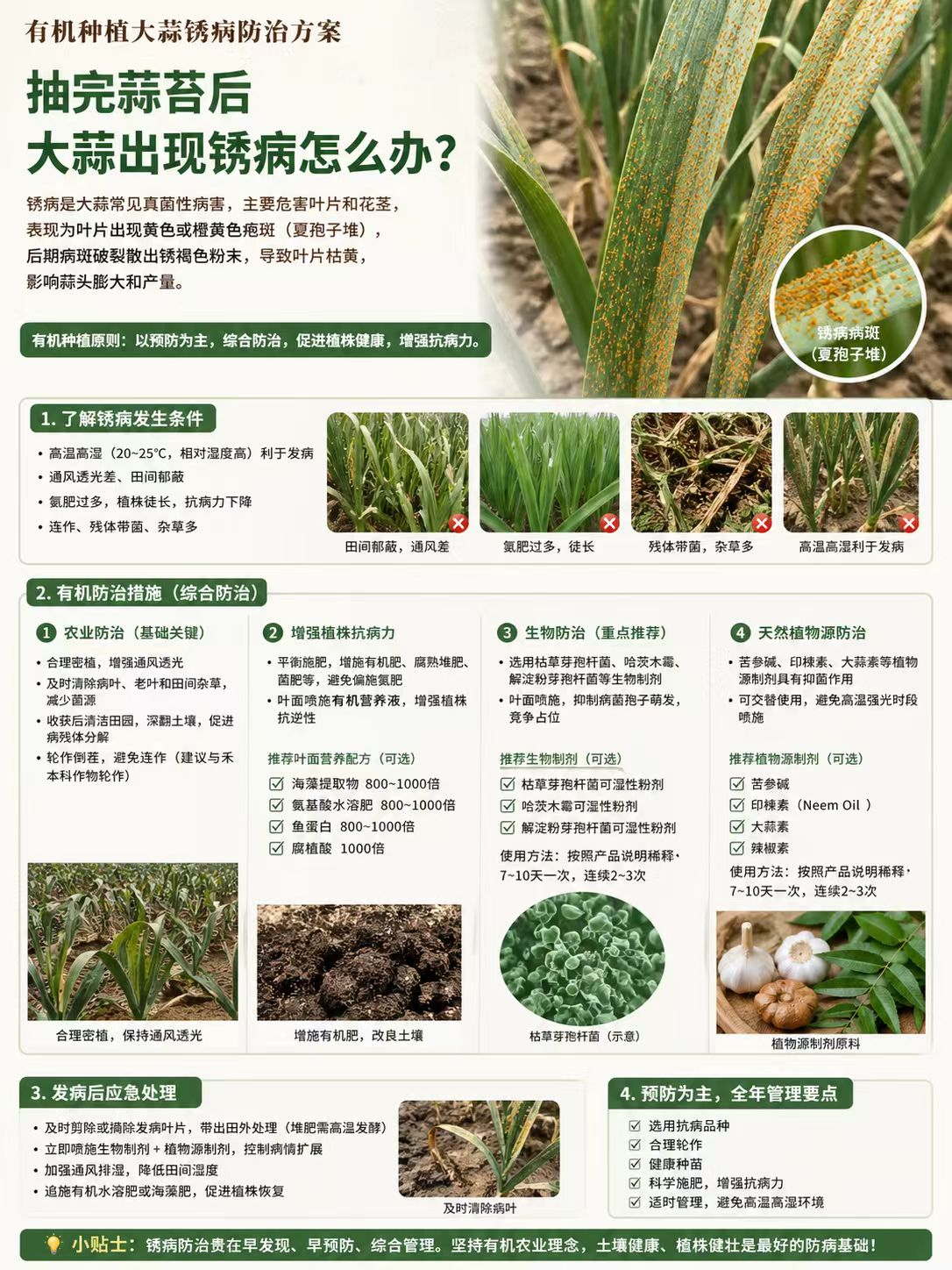
1. First, determine: Is it typical rust disease? Symptoms and characteristics


Leaf blades show orange-yellow/rust-colored powdery spore masses, later turning black and leaves withering. It often starts from the middle and lower leaves. It develops very quickly in high humidity weather.
2. Core Ideas (The Logic Organic Farming Must Shift To)
You cannot 'sterilize,' but you can do three things:
1) Reduce the number of pathogens (physical + biological)
2) Make the environment unfavorable to pathogens (humidity/ventilation)
3) Make the garlic itself more disease-resistant (nutrition + immunity)
3. Specific Prevention and Control Plan (Key Points)
① Immediate Treatment (Loss Control Stage)
1. Remove diseased leaves (very critical): Promptly clean up diseased debris, as rust spores spread very quickly with the wind. If a few leaves are seriously affected, they should be cut off immediately and removed from the field for deep burial or destruction, and should never be casually thrown on field ridges. Bag the leaves first before pruning, as rust spores are like powder and can scatter extensively with even a slight wind or during cutting. It is recommended to cover the diseased leaves with a plastic bag before cutting and then seal it to prevent human-mediated spread during movement. This is the most underestimated but most effective step in organic farming.
2. Control humidity + Ventilation
Control humidity: Stop irrigation for 3–5 days (especially sprinkler irrigation), as rust fungi erupt in hot and humid environments. If it rains after bolting, ensure proper drainage to reduce soil temperature and air humidity, disrupting the environment needed for spore germination.
If conditions allow:
- Enhance ventilation: If planting density is too high and leaves overlap heavily, this can create local high temperature and humidity. Ensure smooth airflow in the field and widen spacing between rows.
- Remove weeds.
② Organic-Approved Fungicidal Solutions (Core)
✔ Organic Pesticide Plan 1: Bordeaux Mixture (First Choice)
Organic approved (mineral source)
Recommended ratio:
1:1:100 (Copper sulfate: Lime: Water)
Effects:
- Inhibit rust fungus spread
- Form a protective film
Lime Sulfur: This is a ‘veteran’ fungicide in organic farming for rust control. In the early stage of disease, spraying 0.3–0.5° Baumé lime-sulfur has extremely strong lethal effect on rust spores.
Note: Avoid spraying at high temperatures (be cautious if air temperature exceeds 30°C to prevent phytotoxicity); spray once every 7 days for 2–3 consecutive times.
Mineral Oil + Sodium Bicarbonate (Baking Soda): This is a very practical 'organic formula.' Sodium bicarbonate can change the pH on the leaf surface, making it difficult for rust spores to germinate. Ratio: 0.5% baking soda water solution, with a small amount of organic-certified mineral oil added as a spreading agent.
✔ Plan 2: Biological Agents (Long-Term Solution)
Recommended combination:
- Bacillus subtilis: Utilizes microbial antagonism to inhibit rust fungus. Choose a high-content powder and spray 2–3 times in early disease stage, once every 7–10 days.
- Trichoderma harzianum
Effects:
- Inhibit rust fungus
- Occupy space to compete
- Improve leaf immunity
👉 Method:
- Foliar spray (evening)
- Every 5–7 days
✔ Plan 3: Organic Plant-Based Fungicides (Supplement)
You can make yourself or purchase:
- Allicin extract
- Matrine
- Azadirachtin (Neem oil)
👉 Characteristics:
- Gentle but sustainable
- Can be rotated with biological agents
③ Quick Plant Recovery (Key Difference)
Plants are 'weak' after bolting; if not recovered, disease continues.
✔ Foliar Nutritional Supplement
Recommended combination:
- Seaweed extract (enhance stress resistance)
- Water-soluble amino acid fertilizer (organic source): Use organic-certified amino acids or fish protein foliar fertilizers. This helps plants quickly repair wounds left after bolting and replenishes nutrients lost due to reproductive growth.
- Micro and trace elements (especially zinc, silicon)
- Wood ash (efficient potassium fertilizer):Spread plant ash in the fields, or use a plant ash leachate for foliar spraying. Plant ash not only provides potassium fertilizer to enhance plant resistance, but its alkalinity can also inhibit the growth of rust fungi. 👉 Key points: Silicon → significantly enhances disease resistance Zinc → boosts immune enzyme activity (you've paid attention to this before 👍)
4. Advanced: Preventing a Second Outbreak (often overlooked)
Key Control Points:
1) Avoid excessive nitrogen
Do not apply nitrogen fertilizer after scape removal
Otherwise, tender leaves → more susceptible to infection
2) Control humidity (the most critical factor)
Conditions for rust outbreak:
Temperature: 15–25°C
Humidity: >90%
👉 Countermeasures:
Water in the morning, avoid wet leaves at night
Do not let leaves stay wet for long periods
3) Crop rotation and soil management (long-term)
Avoid continuous planting (rotate at least every 2–3 years)
Increase application of:
Well-decomposed organic fertilizer
Biofertilizers
To achieve full-process controllable, traceable management of rust in organic garlic cultivation without chemical pesticide residues, establish standardized prevention and control procedures to ensure product quality and compliance with organic certification. Through an integrated management system of "environmental regulation + biological control + nutrient enhancement," stable control of garlic rust can be achieved without any chemical pesticides, ensuring product safety, quality, and organic certification standards.